New Publication: A scalable, cost effective, robotic approach to enrich phosphotyrosine peptides
If you’ve done phosphoproteomics, you know that you need to enrich the phosphopeptides otherwise you’ll just measure unmodified peptides. But did you know you also need a specific enrichment for phosphotyrosine (pY) containing peptides? Relative to phosphoserine and phosphothreonine, phosphotyrosine makes up a very small proportion of all phosphosites. So you have to do an additional enrichment for it, if you are interested in quantifying pY signaling. And you should be interested in pY signaling because its central to cell proliferation, immune response and cancer biology, just to name a few. Additionally, many drugs work by modulating kinases that phosphorylate tyrosine residues.
Despite how important pY signaling is, there is no easy and cheap method to enrich pY peptides. This means its really difficult to do the systems levels analysis of pY signaling across many different cell lines, conditions and replicates. To overcome this, a talented graduate student in the Villén lab, Alexis Chang, came up with R2HaPpY (Rapid-robotic Halo-sSrc Peptide-level Phosphotyrosine enrichment) and this was just publish in EMBO J here. Her approach couples the SH2 pY superbinder to a HaloTag allowing easy coupling of the enrichment reagent to magnetic beads which can be further processed by a magnetic particle processing robot to robustly enrich pY peptides from 96 samples at once.
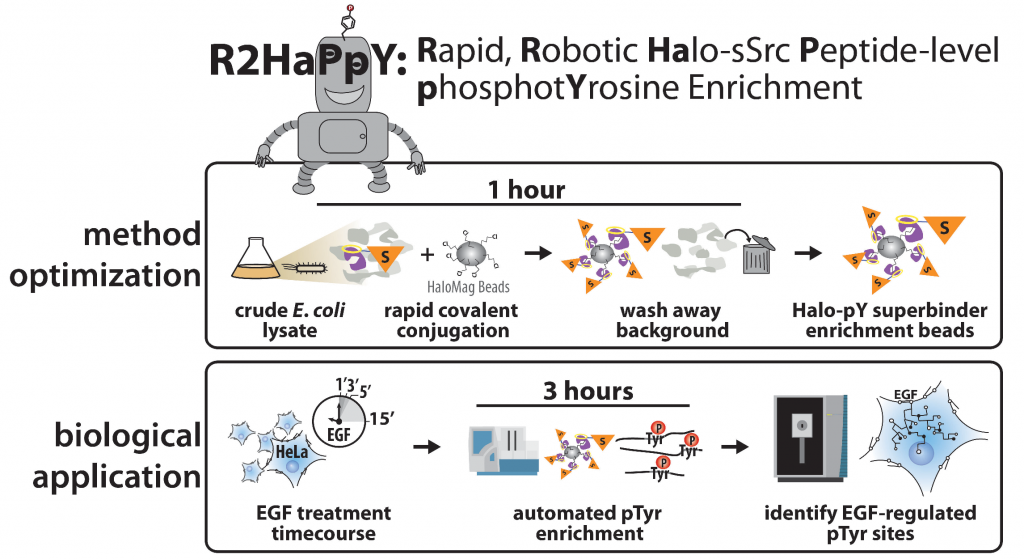
In addition to being 20-fold cheaper than current enrichment approaches, which use commercial pY antibodies, Alexis did a lot of great work to benchmark this method and show that it actually outperforms those approaches as well. From just 1 mg of peptide input, her approach yielded over 1500 pY sites.
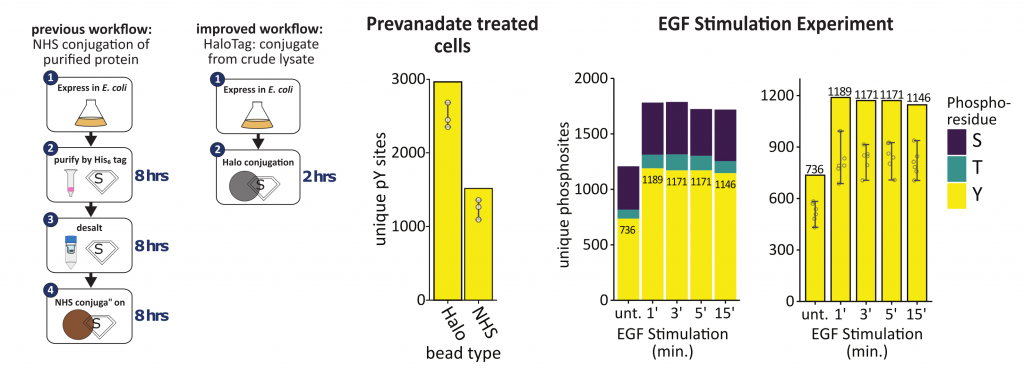
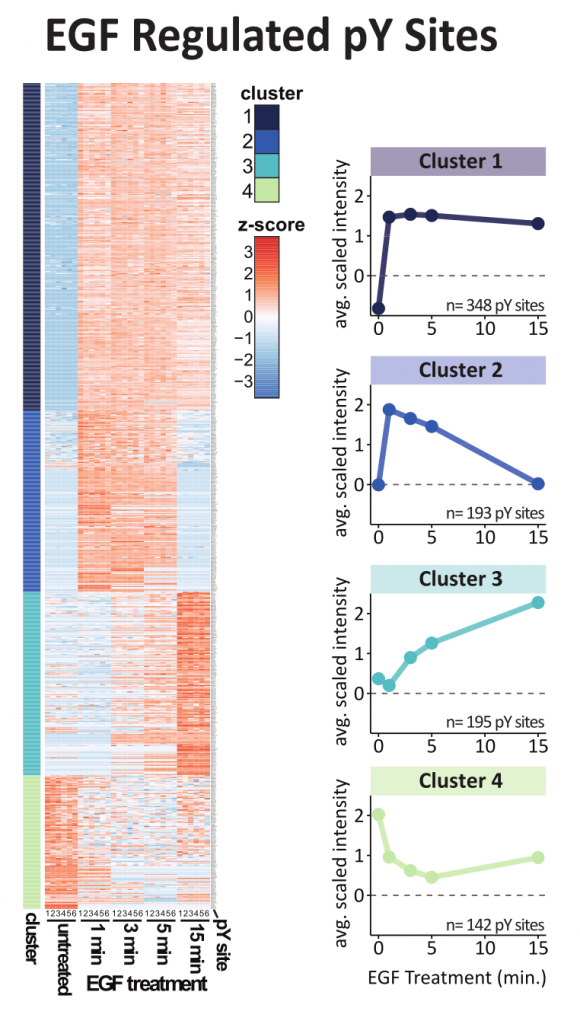
Alexis then went on to show case the power of this approach to study epidermal growth factor (EGF) signaling pathway. Despite this pathway being well studied, Alexis found many new regulated pY sites and produced the largest temporal EGF-responsive pY dataset to date. Interestingly, many of the novel regulated sites are low abundance demonstrating how R2HaPpY is able to capture pY sites that are missed using other approaches. There’s so much cool biology that she uncovered and I’m excited to see what hypotheses come out of this dataset.
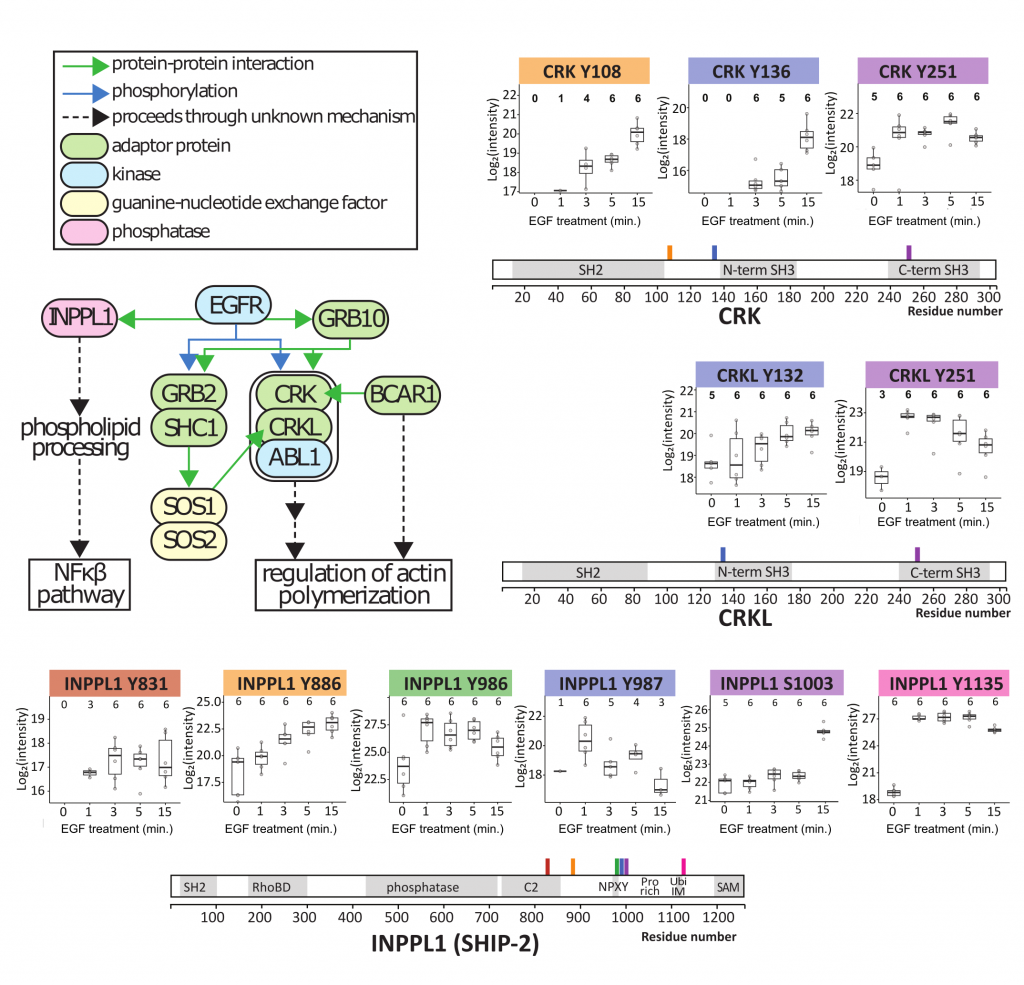
It was awesome to be a part of this study and I’m really excited to apply this approach to study pY signaling. This approach was designed to enable routine enrichment of pY sites and we hope that it opens the door to large, systems-level studies of pY signaling that have not been practical up to this point. It would be so awesome to see more systems level pY signaling data that will advance our understanding of biology as well as open new avenues for therapeutics. If you’re interested in the reagents and in using this approach, please check out the protocol and reach out to Dr. Judit Villén.